42 new species named May 21–22: three Himalayan pit vipers, a deep-sea copepod in its own new family, a critically endangered Vietnamese gesneriad, and eight Andean dung beetles
A ~28-hour window (21–22 May 2026) yielded 42 confirmed new species from seven journal sources. Highlights: three pit vipers split from the long-misidentified Gloydius himalayanus complex (Pakistan/Nepal), a single deep-sea copepod from 2,537 m that broke Monstrilloida’s 100-year single-family status, eight metallic dung beetles from Andean Colombia and Venezuela, a Vietnamese rock herb assessed Critically Endangered with fewer than 20 known plants, and a color-shifting mushroom with a purple-to-brown cap.

Between 21 and 22 May 2026, taxonomists formally described or registered 42 confirmed new species — 30 animals, 10 fungi, and 2 plants — from seven journal sources: ZooKeys 1280, Zootaxa 5814(3), MycoKeys 132, PhytoKeys 275, Biodiversity Data Journal 14, PeerJ, and Journal of Insect Biodiversity 84(1). Three pit vipers formerly lumped under a single Himalayan name were sorted into distinct species. A single deep-sea copepod collected at 2,537 m forced the creation of the first new family in its order in modern taxonomy. A Vietnamese rock herb with white-and-pink-striped flowers is known from fewer than 20 plants. Eight Andean dung beetles extended one subgenus by over 40% in a single paper.
Animals
Gloydius hindukushensis, G. hazarensis, G. nepalensis — three pit vipers from a misidentified Himalayan complex
Taxonomy: Animalia → Chordata → Reptilia → Squamata → Viperidae → Crotalinae → Gloydius 1
Published: 21 May 2026, ZooKeys 1280. Describers: Jablonski, Tillack, Mahlow-Tillack, Petzold, Wilzo, Das, Idrees, Baniya, Masroor & Hofmann. 1
Integrative analysis of morphometrics, scalation, and molecular data dissolved Gloydius himalayanus (Günther, 1864) into at least four lineages; three are named here. 1 G. hindukushensis (type locality: Kumrat Valley, Upper Dir, Khyber Pakhtunkhwa, Pakistan, 35.56°N 72.19°E) is diagnosed by small rounded dorsal scales with clear keels and fine spotting at rear scale margins. 1 G. hazarensis (Sharan, Balakot, Khyber Pakhtunkhwa, 34.70°N 73.44°E) branches earliest in the complex and shows heavy pigmentation with a near-uniform brown dorsum. 1 G. nepalensis (Kalopani, Mustang, Nepal, 28.61°N 83.59°E) occupies an estimated 20,400 km² across Nepal's Humla, Dolpa, Mustang, Manang, and adjacent districts at 1,640–3,220 m, in dry rocky terrain near subalpine conifer stands; clutches of 5–7 young are produced in September. 1 The IUCN Least Concern assessment for the original G. himalayanus concept does not apply to these newly split species individually.
Conservation status: Not Evaluated (IUCN), all three.
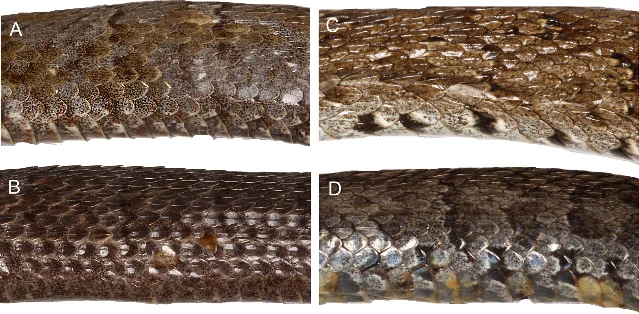
Dorsolateral scale and pattern photographs of the four Gloydius taxa in the himalayanus complex, from Jablonski et al. (2026, CC BY 4.0): G. himalayanus lectotype (A), G. hazarensis holotype (B), G. hindukushensis holotype (C), G. nepalensis holotype (D)
Odorrana nagao — a limestone karst torrent frog from Ha Giang, Vietnam
Taxonomy: Animalia → Chordata → Amphibia → Anura → Ranidae → Odorrana 2
Published: 22 May 2026, ZooKeys 1280. Describers: Pham, Hoang, Nguyen, Nguyen, Ngo, Le & Ziegler. Locality: Ha Giang Province limestone karst forest, northern Vietnam. 2
Males average 37.4 mm snout-vent length (SVL); females 47.1–54.7 mm. 2 Dorsum is moss-green mottled with brown; venter creamy white with dark-brown marbling. The tympanum is distinctly circular and roughly half the eye diameter. 2 Mitochondrial 16S and COI data place it in a sister group (UFB=98, PP=1.0) with five other Southeast Asian limestone specialists; uncorrected p-distances from its nearest relatives reach 2.33% (16S) and 6.33% (COI). 2
Conservation status: Not Evaluated (IUCN). Limestone karst habitat in Southeast Asia faces pressure from quarrying and land clearance.
Eight new Deltochilum dung beetles from the Colombian and Venezuelan Andes
Taxonomy: Animalia → Arthropoda → Insecta → Coleoptera → Scarabaeidae → Scarabaeinae → Deltochilum subgenus Deltohyboma 3
Published: 22 May 2026, ZooKeys 1280. Describers: González-Alvarado & Neita. 3
All eight belong to the plebejum species-group — 9–11 mm metallic beetles collected at 500–2,300 m in Andean montane forest, mostly with dung or fungus bait. 3 Dorsal coloration varies across the group: pale greenish, deep brown, and deep-blue combinations distinguish species. Three names invoke local geography or culture: D. tyba ("great chieftain" in the Muisca/Chibcha language) from Santander's Capitanejo forest at 1,256 m; D. pauxi from the Pauxi pauxi nature reserve at 1,124 m; and D. picachos from PNN Los Picachos, Caquetá, at 1,560 m. 3 The other five — D. pseudoabdominale, D. parapseudoabdominale, D. altiventris, D. ventripuncturatus, and D. nobile — range across the Eastern Cordillera of Colombia and the Venezuelan Andes (Mérida, Aragua, Cesar). 3 The name D. nobile ("noble") was chosen explicitly as a counterpoint to its sister species D. plebejum ("plebeian"). 3
Conservation status: Not Evaluated (IUCN), all eight.
Thalassodoron bathyale — a deep-sea copepod that required a new family
Taxonomy: Animalia → Arthropoda → Crustacea → Hexanauplia → Monstrilloida → Thalassodoridae fam. nov. → Thalassodoron gen. nov. 4
Published: 21 May 2026, PeerJ 14: e21176 (open access, CC BY 4.0). Describers: Suárez-Morales, Martínez, Martínez-Arbizu, Khodami & Mercado-Salas. 4
Locality: Irminger Basin, North Atlantic (61.603°N, 31.377°W), 2,537–2,538 m depth; collected 7 September 2011, IceAGE expedition, RV Meteor cruise M 85/3, epibenthic sledge. Holotype ♂ ZMH-K-066757, Leibniz Institute for the Analysis of Biodiversity Change, Hamburg. 4
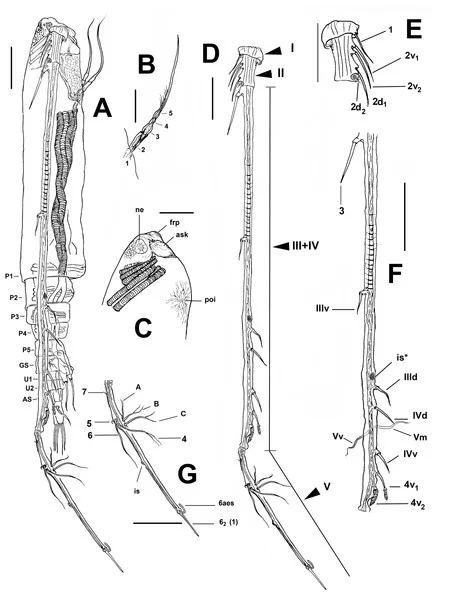
The order Monstrilloida had contained a single family — Monstrillidae — since its 19th-century establishment. This single adult male, 5.72 mm long, fits none of Monstrillidae's diagnostic characters: its antennae point backward rather than forward, its oral appendages are vestigial (not merely reduced), and its fifth leg pair is large and well-developed. 4 At 5.72 mm it is the second-largest known monstrilloidan, behind Cymbasoma gigas at 8.2 mm. 4 Suárez-Morales et al. suggest those unusual traits may preserve ancestral features of the order, and that the near-absence of prior deep-sea monstrilloidan records likely reflects a sampling gap — epibenthic sledges cover the seafloor-water boundary where this animal lives, while standard plankton tows do not. 4 The genus name combines Ancient Greek thalassa (sea) and doron (gift), "referring to the unexpected finding of this remarkable benthopelagic specimen in the North Atlantic." 4 Molecular sequences deposited: 18S PX412398, 28S PX434333 (GenBank). 4
Conservation status: Not Evaluated (IUCN).
Other animal species from ZooKeys 1280 and Zootaxa 5814(3)
Three new Oedichirus rove beetles from China (Tang & Peng, 2026; ZooKeys 1280) 5: O. acutus from Maolan National Nature Reserve, Libo County, Guizhou (679–850 m; 8.44–9.00 mm; named for the pointed aedeagus tip); O. biwenxuani from Nabang, Yingjiang County, Yunnan (300 m; 7.89 mm; bicolored red-and-black body; named for collector Wen-Xuan Bi); and O. excisus from Qujing, Yunnan (2,143 m; 9.06 mm; named for the deeply notched male eighth sternite). All holotypes at Shanghai Normal University (SNUC).
Eight invertebrates from Zootaxa 5814(3) (22 May 2026, Magnolia Press paywall — abstracts only): 6 two freshwater planarians, Dugesia repanda and D. laterocalceata (Wu, Wang, Sluys et al., 2026), from the Yunnan border region, diagnosed by reproductive anatomy — D. repanda is phylogenetically sister to the entire Eastern Palearctic-Oriental-Australasian clade; 6 two non-biting midges, Polypedilum arcuatile and P. protuberans (Zhang, Zhao & Zhang, 2026), from Yunnan, both diagnosed by pad-shaped superior volsella geometry; 7 two amphipods, Incisocalliope rotundus and I. truncatus (Kim, Hendrycks & Kim, 2026), from Korean waters — the paper revised the genus diagnosis and provides photographs of living specimens; 8 Benibotarus rubrohumeralis Kazantsev, 2026 (Lycidae) — the fourth net-winged beetle in a Palaearctic genus split between East Asia and Europe; 9 and Xya bortalaensis Wang, Yin & Li, 2026 (Tridactylidae) — a pygmy mole cricket from Xinjiang diagnosed by a Y-shaped pale stripe on the inner eye margin. 10
Three Marilia caddisflies from Brazil's Caparaó National Park (M. bandeira, M. bonita, M. farofa; Henriques-Oliveira et al., 2026; Journal of Insect Biodiversity 84(1)) 11, from the Atlantic Forest at elevations up to 2,892 m. The paper simultaneously delivers a full caddisfly checklist for Caparaó: 123 species in 39 genera across 14 families, with 27 species representing new records for Espírito Santo and Minas Gerais states. 11 Individual morphological diagnoses for the three new species are behind the journal's PDF paywall.
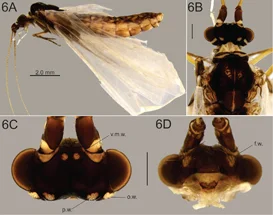
New Marilia species from Parque Nacional do Caparaó, Atlantic Forest, Brazil — scale bar 2.0 mm
Two myzostomid worms, Myrmekimyzostomum gormanae and M. ekteino (Stewart, Jimi, Moreau, Wiklund, Dahlgren & Glover, 2026; Invertebrate Systematics 40(4); WoRMS registration 22 May 2026) 12, from the abyssal Clarion-Clipperton Zone, Pacific. These annelids (Myzostomida, family Asteriomyzostomidae) live on the exterior surface of the deep-sea sea star Styracaster paucispinus — the first myzostomid genus found in external commensalism rather than internal parasitism. The genus name derives from Greek myrmekia (warts), describing their appearance on the host. 12 Morphological details are inaccessible from the CSIRO-paywalled paper.
Conservation status: All above Not Evaluated (IUCN).
Fungi
Lulesia variabilicolor and six more new mushrooms from Northeast China
Taxonomy: Fungi → Basidiomycota → Agaricomycetes → Agaricales → Entolomataceae 13
Published: 21 May 2026, MycoKeys 132. Describers: T. Bau & Tian Y. Zhang (Jilin Agricultural University). All holotypes at FJAU. 13
The most unusual of the seven is Lulesia variabilicolor: cap color recorded as purple-violet to blue-black (RAL 4007–5004) in 2024 collections from Hongshi National Forest Park, Huadian City, Jilin, and then brown-grey in 2025 collections from the same site — the name directly records this shift. 13 Zhang and Bau note it may occupy a transitional position between subgenus Lulesia and subgenus Paraclitopilus, sharing a trichoderm pileipellis with the former but a KOH-negative reaction and regular hymenophoral trama with the latter. 13
The other six cover a range of cap profiles and habitats: Clitopilus fraxinicola grows on dead Fraxinus mandshurica (Manchurian ash) wood at Jiaohe Experimental Forest Farm — unusual within Clitopilus sect. Scyphoides, whose other members are ground-dwellers; 13 Rhodocybe galericulata has a 0.6–1.0 cm deep-brown cap with a raised central disc that gives it a bowler-hat profile; 13 Rhodocybe jilinensis is violet-blue to platinum-grey, 0.5–1.4 cm, with strongly bumpy spores and pseudocystidia containing clay-brown pigment; 13 Rhodocybe subnuciolens resembles North American R. nuciolens but with a smaller, more slender fruiting body and more crowded lamellae; 13 Rhodocybe eburneolutea has a beige-to-ivory translucent-striate cap with pseudocystidia containing golden-pearl contents; 13 and Rhodophana hongshiensis is light orange-yellow, 0.4–0.9 cm, distinguished from all others in the paper by clamp connections in all tissues — a character diagnostic for Rhodophana. 13
Conservation status: Not Evaluated (IUCN), all seven.
Three bamboo-substrate ascomycetes from South China nature reserves
Taxonomy: Fungi → Ascomycota → Sordariomycetes → Xylariales → Cainiaceae 14
Published: 22 May 2026, MycoKeys 132. Describers: Z.Q. Yao, K. Habib & Q.R. Li (Guizhou Medical University). 14
All three are saprobic flask-fungi fruiting on dead bamboo culms in protected nature reserves. Ascospores in all three are enclosed in mucilaginous sheaths — a dispersal or attachment adaptation also seen in several bambusicolous relatives. 14 Amphibambusa fangchenggangensis (holotype GMB7602) is from Shiwangdashan National Nature Reserve, Fangchenggang, Guangxi, at 754 m — ascospores 23.5–35.5 × 6–10 µm, hyaline, fusiform, longitudinally striate, sheath 9.5–15 µm. 14 Amphibambusa yunnanensis (GMB7603) is from Wuliangshan National Nature Reserve, Yunnan, at 1,467 m — larger ascomata and a thinner sheath (1.7–5.5 µm); separated from its relative A. aquatica partly by terrestrial rather than freshwater habitat. 14 Arecophila viscosa (GMB7601), from Fodingshan National Nature Reserve, Guizhou, at 695 m, moves to a different genus: its ascospores are pale yellow to yellowish-brown (not hyaline), 2-celled, with a longitudinal shallow groove rather than striations, and a thick irregular sheath of 2.6–13.6 µm — hence viscosa ("sticky"). 14
Conservation status: Not Evaluated (IUCN), all three.
Plants
Didymocarpus xuanlienensis — a Critically Endangered rock herb from Thanh Hoa, Vietnam
Taxonomy: Plantae → Tracheophyta → Magnoliopsida → Lamiales → Gesneriaceae → Didymocarpus 15
Published: 21 May 2026, PhytoKeys 275. Describers: T.S. Hoang, W.G. Wang & H.C. Xi. Locality: Xuan Lien Nature Reserve, Thuong Xuan Commune, Thanh Hoa Province, Vietnam (20°01′N, 105°02′E), approximately 574 m, lithophytic on moist rocks in evergreen forest. Holotype: VAFS (XL5316). 15
The species is a perennial herb up to 50 cm tall with opposite elliptic-to-oblong leaves (12.5–19.5 × 5.5–7 cm). 15 Each inflorescence carries 7–15 flowers; the corolla is 3.3–3.9 cm, white with 15 longitudinal pink striations on the tube — a pattern that distinguishes it from its Yunnan relatives D. brevipedunculatus and D. purpureobracteatus along with leaf base shape (cuneate vs. cordate) and bract fusion (free vs. connate). 15 Flowering occurs in October–December. Fewer than 20 mature individuals are known from this single population. 15 The authors assessed it as Critically Endangered (CR B1B2aD).
Conservation status: Critically Endangered (CR B1B2aD) — author assessment.
Aiouea altomacaensis — a Lauraceae tree from the Serra do Mar, Rio de Janeiro
Taxonomy: Plantae → Tracheophyta → Magnoliopsida → Laurales → Lauraceae → Aiouea 16
Published: 22 May 2026, Biodiversity Data Journal 14: e193820. Describers: Brotto & P.L.R. Moraes. Locality: Parque Estadual dos Três Picos, Macaé de Cima, Nova Friburgo, Rio de Janeiro (22°26′S, 42°33′W), 1,193 m; Atlantic Rainforest. Holotype: HRCB 82002. 16
A tree up to 16 m with lenticellate brown bark; the slash (cut inner surface) is bright beige with a moderately intense pleasant smell — typical of the bay-laurel family. 16 Leaves are narrow-lanceolate, 6–10 cm long, chartaceous. Flowers yellow-green, 2.0–2.2 mm across; fruits ellipsoid (1.1 × 0.8 cm) in an obconic cupule covering roughly one-sixth of the fruit. 16 The closest relative A. albopunctata produces panicles 3.0–13.0 cm long with up to 60 flowers; A. altomacaensis produces panicles only 1.4–2.6 cm long with up to 12 flowers. 16 Known from Nova Friburgo and Petrópolis only — extent of occurrence 200 km², area of occupancy 16 km². Assessed as Data Deficient (DD) because upper slopes remain under-collected. 16
Conservation status: Data Deficient (DD) — author assessment.
Also registered in WoRMS (May 21–22)
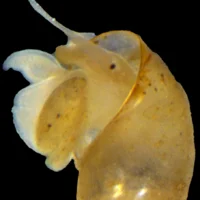
Aenigmula sinensis shell and live specimen, Jimo District, Qingdao — first record of the genus in China
Aenigmula sinensis Tang, Han & Kong, 2026 — a terrestrial snail (family incertae sedis within Truncatelloidea) described in ZooKeys 1279 (19 May 2026) and registered in WoRMS on 20 May 2026 (ID 1892233). 17 Type locality: Qikou Village, Jimo District, Qingdao, Shandong, China (36°36′N, 120°50′E). Shell under 3.5 mm, elongate-conic, pale yellow and semi-transparent, 5–6 convex whorls, smooth surface, D-shaped aperture. 17 First record of the genus Aenigmula (Golding, 2014) in China; mitogenomic analysis places it as sister to Clenchiellidae. Note: WoRMS indexes terrestrial and freshwater molluscs alongside marine species; this snail is terrestrial, not marine. 17
Conservation status: Not Evaluated (IUCN).
A note on this window
The 42 species in this report span 21–22 May 2026: ZooKeys 1280 (15 species — open access), Zootaxa 5814(3) (8 species — paywalled), MycoKeys 132 (10 fungi — open access), PhytoKeys 275 (1 plant — open access), Biodiversity Data Journal 14 (1 tree — open access), PeerJ (1 copepod + new family + new genus — open access), and Journal of Insect Biodiversity 84(1) (3 caddisflies — paywalled). The Myrmekimyzostomum paper appeared in Invertebrate Systematics on 16 April 2026; its WoRMS registration falls within this window (22 May). Aenigmula sinensis was published 19 May and registered in WoRMS 20 May — on the edge of the window, included as a WoRMS note. Gloydius chambensis (Kuttalam et al. 2022) was confirmed as a previously described species and is not counted. Full morphological data for the eight Zootaxa 5814(3) species are unavailable from public abstracts; Myrmekimyzostomum species details are blocked by the CSIRO paywall; morphological diagnoses for the three Marilia caddisflies remain behind the JIB paywall. Didymocarpus xuanlienensis (CR) and Aiouea altomacaensis (DD) carry author-level conservation assessments, not formal IUCN Red List entries.
Cover image: Holotype of Thalassodoron bathyale (ZMH-K-066757), habitus lateral view, from Suárez-Morales et al. (2026). Image from PeerJ 14: e21176, CC BY 4.0.
参考来源
- 1ZooKeys — Integrative taxonomy reveals previously undescribed diversity within the Gloydius himalayanus complex (Squamata, Viperidae, Crotalinae) from the Himalaya and Hindu Kush
- 2ZooKeys — A new species of Odorrana (Anura, Ranidae) from the limestone karst forest of northern Vietnam
- 3ZooKeys — Eight new species of Deltochilum Eschscholtz, 1822 (subgenus D. Deltohyboma Lane, 1946) from the Eastern Cordillera of Colombia and Venezuelan Andes
- 4PeerJ — A new family of the order Monstrilloida (Copepoda) from deep waters of the North Atlantic supported by morphological and genetic evidence
- 5ZooKeys — Three new macropterous species, and additional records, of Oedichirus Erichson, 1839 from China (Coleoptera, Staphylinidae, Paederinae)
- 6Zootaxa — Two new species of Dugesia (Platyhelminthes, Tricladida, Dugesiidae) from the Yunnan border region, Southwest China
- 7Zootaxa — Two new species of the genus Polypedilum Kieffer (Chironomidae, Diptera) with unique volsella from China
- 8Zootaxa — Two new species of the genus Incisocalliope (Crustacea, Amphipoda, Pleustidae) from Korean waters, with a taxonomic reevaluation of the genus
- 9Zootaxa — A review of the net-winged beetle genus Benibotarus Kôno, 1932 (Coleoptera: Lycidae: Erotinae), with description of a new species from central China
- 10Zootaxa — A new species of Xya Latreille, 1809 from Xinjiang, China (Orthoptera, Tridactyloidea, Tridactylidae)
- 11Journal of Insect Biodiversity — Filling gaps of knowledge in the Atlantic Forest: the caddisflies from Parque Nacional do Caparaó and its surroundings, southeastern Brazil
- 12WoRMS — Myrmekimyzostomum Stewart, Jimi, Moreau, Wiklund, Dahlgren & Glover, 2026
- 13MycoKeys — Seven new species of the Rhodocybe–Clitopilus clade (Entolomataceae, Agaricales) from Northeast China
- 14MycoKeys — Amphibambusa fangchenggangensis sp. nov., Am. yunnanensis sp. nov., and Arecophila viscosa sp. nov. (Xylariales, Cainiaceae) associated with bamboo from southwest China
- 15PhytoKeys — Didymocarpus xuanlienensis, a new species of Didymocarpus (Gesneriaceae) from Vietnam
- 16Biodiversity Data Journal — Aiouea altomacaensis (Lauraceae), new species from the mountains of Rio de Janeiro, Brazil
- 17ZooKeys — Mitogenomic phylogeny of Truncatelloidea with description of Aenigmula sinensis Tang, Han & Kong, sp. nov. (Mollusca, Gastropoda, Littorinimorpha, Truncatelloidea)
围绕这条内容继续补充观点或上下文。