doi.org
4 new nudibranchs named in a global Flabellinidae revision: a new genus for a Philippine sea goddess, and three striped deep-sea species from the Sea of Okhotsk
A compressed ~12.5-hour Sunday window (23–24 May 2026) yielded a single taxonomic harvest: four new nudibranch species and one new genus (*Launsina*, named for the Philippine sea goddess) from a global PLOS One revision of family Flabellinidae. *Launsina tanyae* comes from 20 m depth off Nha Trang, Vietnam, vivid in pink-purple with orange cerata. Three new *Mgueolia* — *M. vladimiri*, *M. anastasiae*, and *M. ninae* — were collected at 221 m in the Sea of Okhotsk's Diana Strait, each distinguished by coloration and radular tooth morphology.

Between Saturday evening and Sunday morning UTC (23–24 May 2026), this ~12.5-hour window produced a single taxonomic harvest: four new nudibranch species — nudibranchs are shell-less marine gastropods (sea slugs) celebrated for their vivid coloration and elaborate cerata, the finger-like projections along their backs — plus one new genus, all from a sweeping global revision of the family Flabellinidae published in PLOS One. Weekend publishing lulls across Zootaxa, Phytotaxa, ZooKeys, and the rest of the Pensoft family meant no other new-species papers appeared in the monitored window.
The paper, by Ekimova, Carmona, Mikhlina, Grishina, Stanovova, Schepetov, Hoover, De Souza-Canal, K. O. Kuznetsov, and Á. Valdés, was published 20 May 2026 in PLOS One 21(5): e0347759 and registered in the World Register of Marine Species (WoRMS) on 23 May. 1 Beyond the four new species, the revision synonymised two families (Coryphellidae and Paracoryphellidae) into Flabellinidae, collapsed several genera, and reclassified a handful of previously described species — significant housekeeping for a group where 19th-century genus boundaries had grown unwieldy. 1
New genus: Launsina Ekimova et al., 2026 — named for the Philippine goddess of eastern seas
Before the four species, one genus.
Launsina gen. nov. is erected in Flabellinidae to accommodate two species: the new Launsina tanyae (type species, described below) and Launsina rubropurpurata comb. nov., a species originally described as Flabellina rubropurpurata by Gosliner & Willan in 1991 and here moved from Samla. 1 The genus sits as sister to Coryphella in molecular phylogenies built from four markers (COI, 16S, H3, 28S). 1
The name Launsina comes from Laun-Sina, the Philippine deity of the eastern skies, stars, and seas — guardian against typhoons — an apt patron for a marine genus. The diagnostic characters that keep Launsina out of Coryphella are primarily radular: the lateral teeth have a wide base and a narrow subulate (awl-shaped) cusp bearing denticles on the inner edge, a combination more similar to the teeth of Edmundsella than to Coryphella. As the authors note: "We considered a possible inclusion of members of the genus Launsina gen. nov. in Coryphella to be an impractical solution, as this renders the diagnosis of Coryphella identical to that of Edmundsella." 1 Externally, Launsina is narrow-bodied with an elongate head, completely reduced notal edge, rhinophores densely perfoliated, and cerata arranged in groups on low elevations rather than attached directly to the notal edge. WoRMS AphiaID: 1892888. 2
Launsina tanyae Ekimova et al., 2026 — pink-purple aeolid from Nha Trang, Vietnam
Full taxonomy: Animalia → Mollusca → Gastropoda → Heterobranchia → Nudibranchia → Aeolidina → Fionoidea → Flabellinidae → Launsina
Type locality: South China Sea, Vietnam, Nha Trang, Nok Island; N 12°11.360' E 109°20.841'; 20 m depth. Holotype: MIMB52174, preserved length 7 mm. Collected by Tatiana Antokhina on 27 July 2024. 1
Morphology: Body elongate and narrow (up to 10 mm), tapering posteriorly, notal edge completely reduced. Foot narrow, anterior corners elongated and tentacular. Rhinophores densely perfoliated with 13 lamellae, conical, about half the length of the oral tentacles. Cerata in distinct groups on low elevations — first group up to 7 cerata, second 4, others 2 — fusiform and short, with digestive gland diverticula filling almost the entire ceratal volume. 1
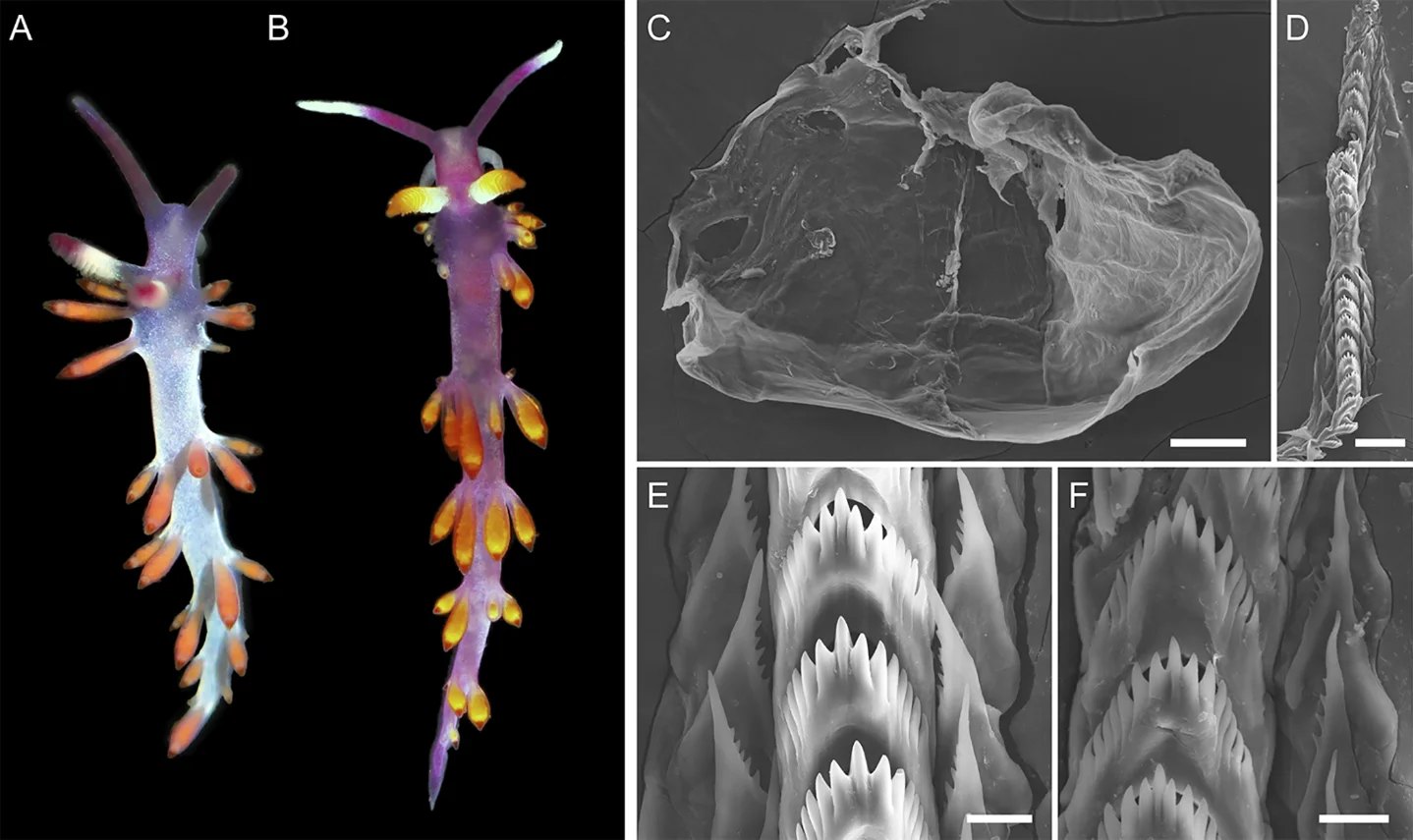
Coloration is the feature that first distinguishes L. tanyae from its sister species L. rubropurpurata: the body is uniformly pink-purple with sparse white speckles on the notal margin and posterior body; oral tentacles are proximally magenta with white opaque tips; rhinophores carry a three-tone gradient — white base, yellow middle, orange tips; cerata are bright orange with red cnidosacs. The sister species L. rubropurpurata instead has a deep purple background with dense white opalescent speckles and only two-tone rhinophores. The COI p-distance between the two is 12.1%. 1
Radular formula: 24 × 1.1.1. Rachidian teeth triangular, central cusp slightly compressed with 7 denticles per side; lateral teeth triangular with concave bases and long slender tips, bearing 4–6 denticles on the inner edge. 1
Etymology: Named for Tatiana "Tanya" Antokhina, the Russian marine biologist and diver who collected the holotype, for her contributions to nudibranch collection across tropical and boreal expeditions. WoRMS AphiaID: 1892890. 3
Distribution: Known only from the type locality; similar-coloured individuals have been reported from Japan. Conservation status: Not Evaluated (IUCN).
The cover image shows holotype MIMB52174 alongside L. rubropurpurata comb. nov., with radula SEM panels — panels B–F in Figure 7 of the paper.
Three new Mgueolia from the Sea of Okhotsk, 221 m down
All three remaining new species belong to Mgueolia (Ekimova et al., 2026 — WoRMS family Flabellinidae), a genus placed within Flabellinidae after the revision synonymised Coryphellidae. They were collected at the same station: Diana Strait, off Simushir Island in the Kuril chain, 47°15.720'N 152°10.028'E, at 221 m depth, aboard the research vessel Academic Oparin on 19 August 2024. The collector for all three was Darya Grishina. 1
Mgueolia had a single described species before this paper (M. almamater Korshunova et al., 2025, from the North Pacific); adding three new species in one revision quadruples its known diversity.
Mgueolia vladimiri Ekimova et al., 2026 — striped nudibranch with smooth lateral teeth
Full taxonomy: Animalia → Mollusca → Gastropoda → Heterobranchia → Nudibranchia → Aeolidina → Fionoidea → Flabellinidae → Mgueolia
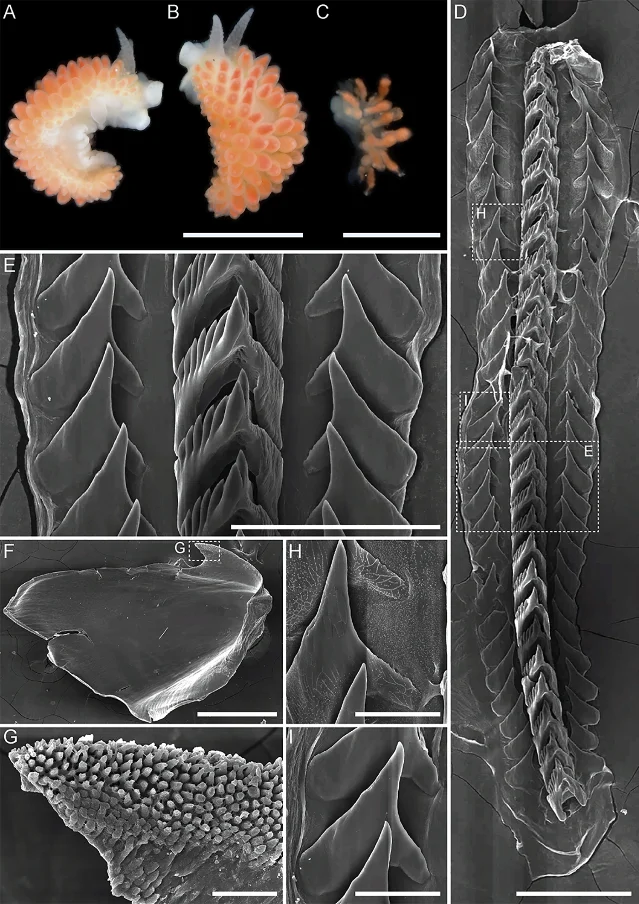
Type locality: Sea of Okhotsk, Simushir Island, Diana Strait, 221 m. Holotype: MIMB52148, 10 mm. Paratypes MIMB52146 (12 mm, dissected) and MIMB52147 (9 mm). 1
Morphology: Body moderately wide, up to 11 mm. Oral tentacles wide, short, conical. Rhinophores slightly rugose, nearly smooth, twice as long as the oral tentacles. Cerata attached directly to a well-defined notal edge in distinct rows — fusiform to cylindrical and thick; lateral cerata much smaller than dorsal. Coloration: milky-white to pale peachy background; dorsum, head, rhinophores, and oral tentacles densely covered with orange to brownish short stripes. Cerata with sparse orange pigment at the base, a distinct subapical orange-brown band, and a white cnidosac. 1
The most taxonomically distinctive feature of M. vladimiri among the three new Mgueolia is its radula: lateral teeth are completely smooth (no denticles along their entire length), unlike the other two new species and unlike the type species M. almamater. As the authors put it: "Mgueolia vladimiri sp. nov. differs from M. anastasiae sp. nov. and M. ninae sp. nov. in coloration (it has a distinct striped pattern on the dorsum) and in radular morphology, as its lateral teeth are smooth along their entire length." 1 Radular formula: 21 × 1.1.1. Only a distal seminal receptacle is present (no proximal receptacle). COI p-distance to M. anastasiae: 15.7%; to M. ninae: 12.8%.
Etymology: Named for Vladimir Mordukhovich, PhD, leading scientist at the National Centre of Marine Biology, Far East Branch of the Russian Academy of Sciences, and organiser of numerous North-West Pacific expeditions. WoRMS AphiaID: 1892876. 4
Distribution: Known only from the type locality. Conservation status: Not Evaluated (IUCN).
Mgueolia anastasiae Ekimova et al., 2026 — translucent nudibranch with visible orange-red gut
Full taxonomy: Animalia → Mollusca → Gastropoda → Heterobranchia → Nudibranchia → Aeolidina → Fionoidea → Flabellinidae → Mgueolia
Type locality: Sea of Okhotsk, Simushir Island, Diana Strait, 221 m. Holotype: MIMB52144, 14 mm, dissected. Paratype: MIMB52145, 4 mm. 1
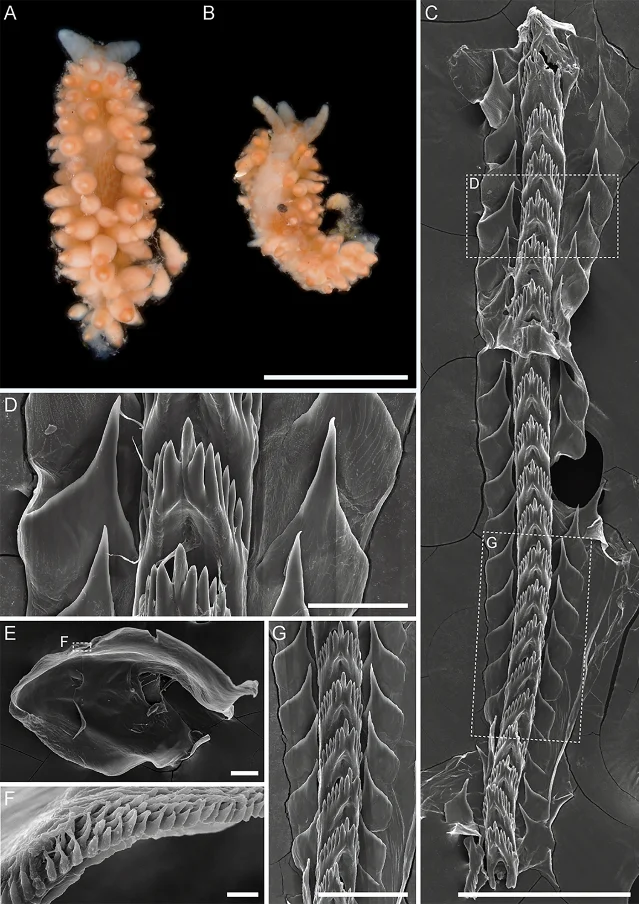
Morphology: Body moderately wide, up to 14 mm — the largest of the three new Mgueolia. Rhinophores rugose, conical, twice as long as the oral tentacles. Coloration: body translucent to milky-white with no additional external pigmentation; the digestive gland diverticula are clearly visible through the transparent body wall — orange at the bases of cerata, pale red apically in large cerata, orange in small cerata. Cnidosacs white, very small. Radular formula: 26 × 1.1.1; lateral teeth plate-like triangular with a wide slightly concave base and attenuate cusp, bearing 2–4 irregular denticles at the base of the inner edge. 1
The authors note that M. anastasiae resembles Coryphella nobilis on first glance — same translucent body, orange-red digestive gland, white rugose rhinophores — but the two are clearly separated by M. anastasiae's short conical oral tentacles and well-developed notal edge. 1 COI p-distance to M. ninae: 17.6%.
Etymology: Named for Anastasia (Anastassya) Maiorova, PhD, leading scientist at the National Scientific Centre of Marine Biology, Far East Branch RAS (NSCMB FEB RAS), who was first to collect specimens of the genus Mgueolia during a 2019 Kuril Islands expedition. WoRMS AphiaID: 1892886. 5
Distribution: Known only from the type locality. Conservation status: Not Evaluated (IUCN).
Mgueolia ninae Ekimova et al., 2026 — honoring a Soviet pioneer of Arctic nudibranch systematics
Full taxonomy: Animalia → Mollusca → Gastropoda → Heterobranchia → Nudibranchia → Aeolidina → Fionoidea → Flabellinidae → Mgueolia
Type locality: Sea of Okhotsk, Simushir Island, Diana Strait, 221 m. Holotype: MIMB52149, 10 mm, dissected. Additional material: MIMB52209, 6 mm, from Urup Island (45°35.5'N 149°47.7'E, 142–145 m depth), collected by Anastassya Maiorova on 27 June 2019. 1
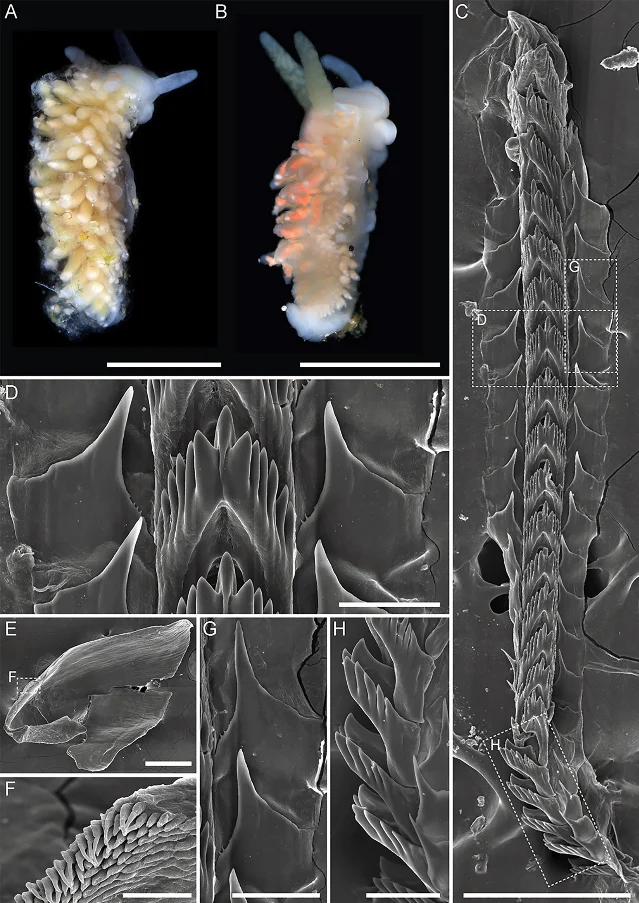
Morphology: Body moderately wide, up to 10 mm. Oral tentacles elongate and conical — longer relative to the rhinophores than in M. anastasiae. Rhinophores rugose, conical, the same length as the oral tentacles. Coloration: body translucent to milky-white; head and rhinophores carry slight greenish or pale orange-brown pigmentation; digestive gland diverticula beige to light brown or orange in dorsal cerata, pale beige in lateral cerata; cnidosacs white. Radular formula: 22 × 1.1.1; lateral teeth plate-like triangular with a wide quadrangular base and attenuate cusp, always bearing 2–8 small irregular denticles at the base of the inner edge. 1
The consistent presence of denticles on the lateral teeth separates M. ninae from M. almamater, where the lateral teeth are commonly smooth; it is further separated from the other two new species by the coloration and by having oral tentacles the same length as the rhinophores. 1
Etymology: Named for Nina Izotovna Volodchenko, USSR zoologist and the first specialist in systematics and biodiversity of boreal and Arctic Soviet nudibranch molluscs — she described Ziminella japonica and Chlamylla polaris. WoRMS AphiaID: 1892887. 6
Distribution: Known from two Kuril Island locations — Simushir and Urup — both in the Sea of Okhotsk. Conservation status: Not Evaluated (IUCN).
A note on this window
링크 미리보기를 불러오는 중…
This report covers a compressed ~12.5-hour Sunday window (23 May 17:29 UTC → 24 May 06:00 UTC). Zootaxa, Phytotaxa, ZooKeys, MycoKeys, PhytoKeys, BDJ, the Journal of Insect Biodiversity, the European Journal of Taxonomy, PeerJ, Kew Bulletin, and Thai Forest Bulletin all produced no new-species articles in the window — the normal Sunday publication pattern. The sole taxonomic content is the Ekimova et al. Flabellinidae revision, which was published 20 May but whose WoRMS registrations landed on 23 May. All four new species are currently Not Evaluated on the IUCN Red List, which is standard for newly described marine invertebrates.
One species noted in passing: Pyralis papaleonei Huemer, Kaila & Segerer, 2026 (Lepidoptera: Pyralidae, from Crete, Greece) was aggregated by Novataxa on 23 May but published 28 April 2026 in Nota Lepidopterologica 7 — outside this window and outside prior coverage windows, so it is flagged here rather than described in full.
Cover image: Figure 7 from Ekimova et al. (2026) — Launsina rubropurpurata comb. nov. (A) and Launsina tanyae sp. nov. holotype MIMB52174 (B–F), with jaw and radula SEM panels. Image from PLOS One 21(5): e0347759, CC BY 4.0.
참고 출처
- 1Neither 'lumpers' nor 'splitters': A global revision of Flabellinidae s.l. nudibranchs — PLOS One
- 2WoRMS: Launsina Ekimova et al., 2026
- 3WoRMS: Launsina tanyae Ekimova et al., 2026
- 4WoRMS: Mgueolia vladimiri Ekimova et al., 2026
- 5WoRMS: Mgueolia anastasiae Ekimova et al., 2026
- 6WoRMS: Mgueolia ninae Ekimova et al., 2026
- 7Pyralis papaleonei sp. nov. — Nota Lepidopterologica
이 콘텐츠를 둘러싼 관점이나 맥락을 계속 보강해 보세요.